
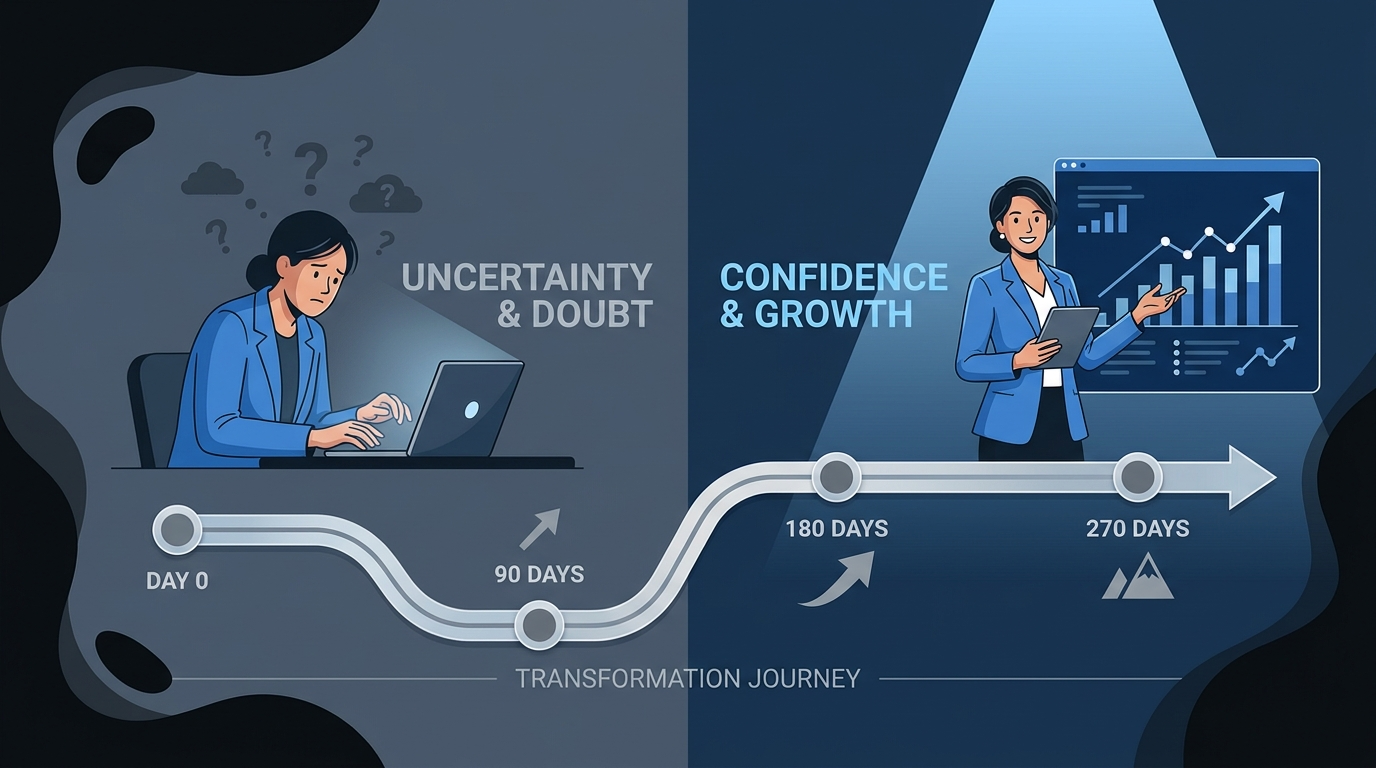
Overnight Confidence Myth: 90-Day Mid-Career Case Study
The Myth of Overnight Confidence: A Mid-Career Case Study
Picture this: Sarah, a 32-year-old marketing director, scrolling through LinkedIn at 11 PM, watching colleagues effortlessly share insights while she sits paralyzed by the blinking cursor. Sound familiar? Overnight confidence feels like everyone else's superpower—except yours.
Here's the thing about confidence: it's not a light switch you flip. It's more like water slowly filling a bucket, one strategic drop at a time. But what if we could measure those drops? Track the exact moments when imposter syndrome loosens its grip?
That's exactly what we did with Sarah's 90-day journey from invisible expert to visible thought leader. No fluff, no overnight transformations—just hard data on what actually works when you're stuck in the messy middle of your career.
The Starting Point: Measuring Invisible Expertise
Sarah came to us with what we call "invisible expertise syndrome." She had the knowledge, the track record, even the results—but zero visibility. Her baseline metrics painted a familiar picture:
- LinkedIn engagement rate: 0.2% (industry average: 2-3%)
- Speaking opportunities: 1 internal presentation in 18 months
- Industry recognition: Zero mentions in trade publications
- Network growth: 12 new connections in 6 months
- Self-assessed confidence level: 3/10
The kicker? Sarah had just led a campaign that generated $2.3M in pipeline revenue. She had the goods—she just couldn't talk about them.
Week 1-30: The Foundation Phase
Forget the motivational posters. Real confidence building starts with systems, not inspiration. We implemented what we call the "Evidence Collection Protocol"—a daily practice of documenting wins, however small.
Sarah's first system was ridiculously simple: a 2-minute daily voice memo cataloging one professional achievement. Not life-changing stuff—just "successfully negotiated vendor rates down 15%" or "teammate thanked me for clear project brief."
The surprising result? Within three weeks, Sarah's self-assessment jumped from 3/10 to 5/10. Why? Because she finally had proof of her own competence, documented in her own voice.
Metrics from Month 1:
- Evidence entries: 28 (goal: 21)
- LinkedIn posts: 3 (previous month: 0)
- New connections: 15 (vs. 2 in previous month)
- Speaking inquiry: 1 (first in 2 years)
Week 31-60: The Visibility Experiment
Here's where most personal development advice goes wrong—it assumes confidence comes first, then action. Our data suggests the opposite. Action, measured consistently, builds genuine confidence.
Sarah's second system: the "Teaching Tuesday" protocol. Every Tuesday, she shared one tactical insight from her Evidence Collection. Nothing groundbreaking—just honest, specific observations about what worked (and what didn't) in her marketing projects.
The magic wasn't in the content quality—it was in the consistency. Each post became proof that she could survive visibility. And gradually, imposter syndrome lost its grip because the imposters don't show up every week with useful insights.
Month 2 Breakthrough Metrics:
- LinkedIn engagement rate: 1.8% (up from 0.2%)
- Profile views: 340% increase
- Inbound messages: 12 (vs. 1 in previous 6 months)
- Speaking opportunities: 3 inquiries
- Industry podcast invitation: 1
But here's what the numbers don't show: Sarah stopped rehearsing conversations in her car. She started raising her hand in leadership meetings. Small stuff that compounds.
Week 61-90: The Compound Effect
By month three, something shifted. Sarah's confidence wasn't fragile anymore—it was evidence-based. She had data proving she could add value publicly, consistently, without catastrophic embarrassment.
Her third system: "Strategic Amplification." Instead of creating new content, she curated and commented thoughtfully on industry discussions. This approach multiplied her visibility while playing to her analytical strengths.
Final 30-Day Results:
- Self-assessed confidence: 7.5/10
- LinkedIn followers: +267 (targeted industry professionals)
- Speaking engagements booked: 2
- Media mentions: 3 (including one industry roundup)
- Job inquiry: 1 (unsolicited senior role)
- Internal promotion discussion: Initiated by her manager
The Anti-Hype Lessons: What Actually Worked
After analyzing Sarah's transformation, three patterns emerged that contradict most confidence coaching advice:
1. Documentation beats affirmation. Sarah's voice memos created an objective record of competence. You can't argue with your own evidence.
2. Consistency trumps perfection. Her Tuesday posts weren't brilliant—they were reliable. Reliability builds trust, including self-trust.
3. Systems create confidence, not the reverse. Sarah didn't feel confident and then start posting. She started posting systematically, and confidence followed.
Your 90-Day Confidence System
Want to replicate Sarah's results? Here's the exact framework, adapted for any mid-career professional:
Days 1-30: Evidence Collection
- Daily 2-minute achievement documentation
- Weekly review of evidence patterns
- One monthly "teaching moment" share
Days 31-60: Consistent Visibility
- Weekly insight sharing (same day, same format)
- Engage meaningfully with 3 industry posts daily
- Accept one speaking/writing opportunity (however small)
Days 61-90: Strategic Amplification
- Curate and comment on industry discussions
- Seek collaboration opportunities
- Document and share your system's results
The Data-Driven Confidence Blueprint
Here's what Sarah's journey proves: confidence isn't a personality trait—it's a skill you can systematically develop. The key is treating it like any other professional competency: measure it, practice it, improve it.
Most confidence advice feels like trying to fill a bucket with a hole in it. You pump yourself up, but the effect leaks away by Tuesday. Sarah's approach plugged the hole first—creating systems that generate evidence of competence faster than imposter syndrome can drain it.
The numbers don't lie: 90 days, documented systems, measurable results. No overnight transformation required.
Ready to build your own evidence-based confidence? Start with tomorrow's 2-minute achievement documentation. Because the best time to start building visible expertise was yesterday. The second-best time is right now.


