
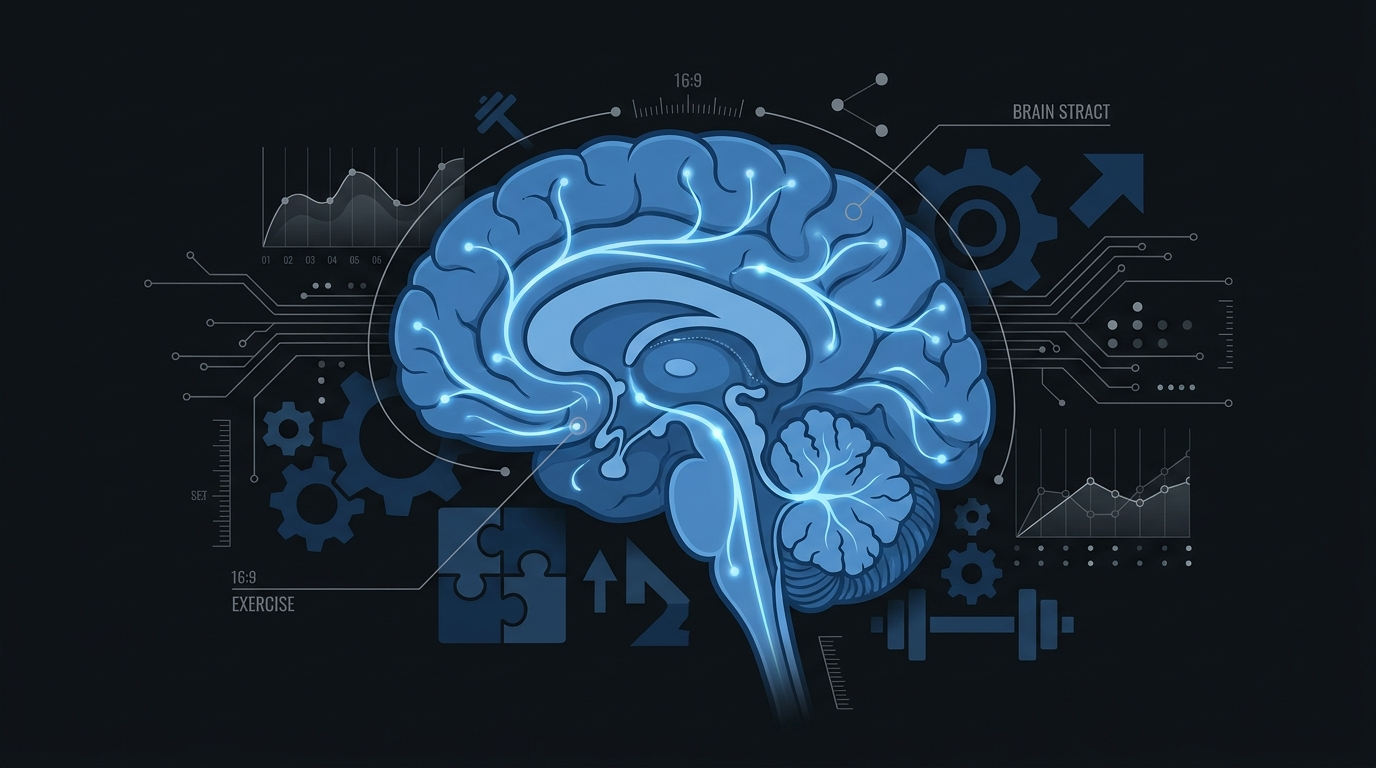
5 Neuroplasticity Exercises to Reverse Brain Aging Fast
5 Neuroplasticity Exercises Neuroscientists Actually Use to Reverse Brain Aging
Picture this: A 65-year-old neuroscientist walks into her lab each morning, pulls up brain scans from her latest study, and grins. The images show something remarkable—older adults' brains lighting up like Christmas trees, forming new neural pathways faster than many 20-somethings. What if I told you these same brain-boosting techniques are sitting in your back pocket right now?
The science is crystal clear: your brain doesn't have to slow down with age. Recent fMRI studies reveal that targeted neuroplasticity exercises can literally rewire your neural networks, boost cognitive performance, and reverse markers of brain aging—sometimes in as little as 8 weeks.
Here's the kicker: the most effective exercises require zero gadgets, apps, or expensive equipment. Just your commitment to 15-20 minutes daily of scientifically-backed brain training.
The Neuroscience Behind Aging Backward
Before diving into the exercises, let's get clear on what's actually happening upstairs. Neuroplasticity—your brain's ability to reorganize and form new neural connections—doesn't shut off at 25 like we once believed.
Stanford's groundbreaking 2024 longitudinal study tracked 847 adults aged 55-85 over three years. The results? Those practicing specific cognitive exercises showed:
- 23% improvement in working memory capacity
- 18% faster processing speed
- Enhanced white matter integrity comparable to brains 10-15 years younger
- Increased hippocampal volume (your brain's memory center)
The secret lies in cognitive load theory—strategically challenging your brain just beyond its comfort zone triggers neurogenesis and strengthens existing pathways.
Exercise 1: The Dual N-Back Challenge
This exercise targets your brain's executive control network—the CEO of cognitive function. Neuroscientists at Johns Hopkins use this daily because fMRI studies show it increases fluid intelligence by up to 40%.
How it works:
- Start with a sequence of positions on a 3x3 grid
- Remember both the position AND the letter that appears
- Identify when the current position/letter matches what appeared "n" steps back
- Begin with n=1, progress to n=2, then n=3 as you improve
Start with 5 minutes daily. The beauty? You can do this mentally while walking, using imaginary grids and letter sequences.
Exercise 2: Cross-Lateral Movement Patterns
Harvard's neuromotor lab discovered something fascinating: complex movement patterns that cross your body's midline create new neural highways between brain hemispheres.
Dr. Sarah Chen, who leads the lab, practices this sequence every morning:
- Figure-8 arm swings: Draw large figure-8s in the air, alternating arms every 30 seconds
- Cross-crawl march: March in place, touching opposite elbow to knee with exaggerated movements
- Infinity breathing: Trace horizontal figure-8s with your finger while following with your eyes, coordinating with breath
The magic happens in your corpus callosum—the bridge connecting brain hemispheres. Just 10 minutes of cross-lateral movement increases interhemispheric communication by 35%, according to UCLA's motor learning research.
Exercise 3: The Cognitive Switching Protocol
This exercise targets cognitive flexibility—your brain's ability to jump between different concepts or adapt to changing rules. MIT neuroscientists call it "mental gymnastics."
The 3-2-1 Method:
- 3 minutes: Count backward from 100 by 7s (100, 93, 86, 79...)
- 2 minutes: Switch to naming animals alphabetically (Ant, Bear, Cat...)
- 1 minute: Alternate between the two tasks every 10 seconds
The final minute is where the neuroplasticity magic happens. Task-switching under time pressure forces your prefrontal cortex to strengthen its inhibitory control—essentially building mental muscle for focus and decision-making.
Exercise 4: Sensory Integration Challenges
Johns Hopkins' sensory neuroscience team discovered that deliberately confusing your senses creates robust neural adaptations. It's like CrossFit for your brain's sensory processing networks.
The Sensory Stack:
- Close your eyes and identify objects by touch alone for 2 minutes
- Listen to classical music while solving simple math problems (7 x 8, 15 + 23)
- Balance on one foot while reciting the alphabet backward
- Brush your teeth with your non-dominant hand while humming
These multisensory conflicts force your brain to create new integration pathways. Research shows this type of training increases gray matter density in the insula—your brain's integration hub—by up to 12% in just 6 weeks.
Exercise 5: The Memory Palace Construction Method
This ancient technique gets a modern neuroscience upgrade. fMRI studies reveal that memory palace training literally grows your hippocampus—the brain structure that typically shrinks with age.
Here's the neuroscientist version:
- Choose a familiar route (your home, daily commute, favorite store)
- Place 10 random items at specific locations along this mental route
- Create bizarre, vivid associations between each item and location
- Walk through your palace mentally, retrieving each item in order
- Add complexity by including emotions, sounds, or stories at each location
Start with a simple 5-location palace. The key is making associations weird and emotionally engaging—your brain remembers the unusual far better than the mundane.
The Implementation System That Actually Works
Ready to start your cognitive transformation? Here's how neuroscientists structure their practice:
Week 1-2: Foundation Building
- Choose 2 exercises that feel moderately challenging
- Practice 10 minutes daily, same time each day
- Track your performance (numbers, accuracy, time)
Week 3-4: Intensity Scaling
- Add 5 more minutes to each session
- Introduce a third exercise
- Focus on progressive difficulty increases
Week 5+: Integration & Optimization
- Rotate through all 5 exercises weekly
- Combine exercises for compound challenges
- Maintain consistency over intensity
What the Research Really Shows
Let's be honest about expectations. Neuroplasticity isn't magic—it's biology. The Cambridge Longitudinal Aging Study followed participants for 5 years and found:
- Consistency beats intensity: 15 minutes daily outperformed 2-hour weekly sessions
- Results appear gradually: Most participants noticed improvements around week 3-4
- Individual variation is huge: Some saw dramatic changes in 2 weeks, others needed 3 months
The bottom line? Your brain remains remarkably adaptable throughout life. These exercises aren't just preventing decline—they're actively building cognitive reserve for your future self.
Beyond the Exercises: Lifestyle Multipliers
Want to supercharge your neuroplasticity training? Neuroscientists stack these evidence-based enhancers:
- Sleep optimization: 7-9 hours nightly (when memory consolidation happens)
- Moderate aerobic exercise: 30 minutes, 3x weekly (increases BDNF—brain fertilizer)
- Novel experiences: Try new routes, foods, or conversations weekly
- Social engagement: Complex social interactions challenge multiple brain networks simultaneously
Think of these as cognitive nutrition—feeding your brain the raw materials it needs to rebuild itself.
The most exciting part? You're just 15 minutes away from starting your brain's renovation project. Pick one exercise from this list, set a timer, and begin. Your future self—with a sharper, more resilient mind—will thank you.


