
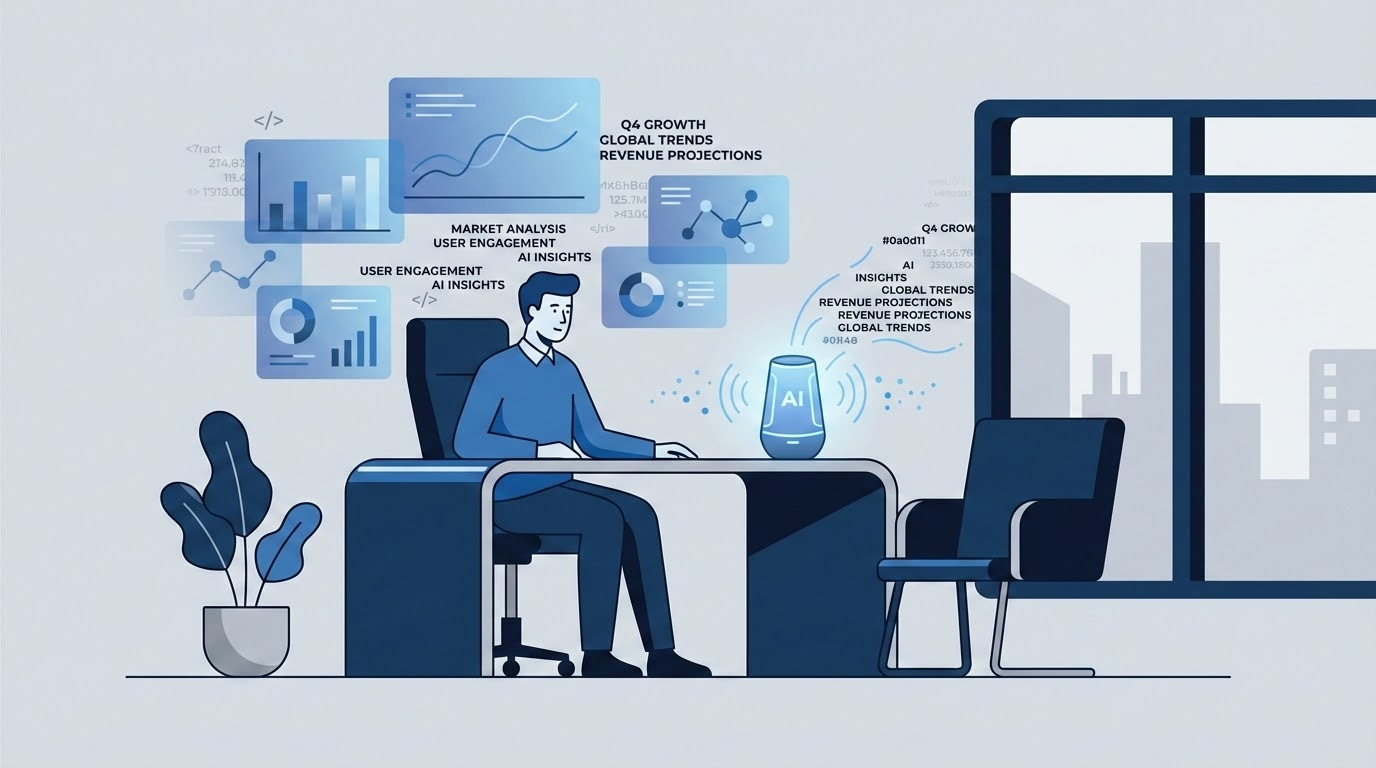
Why CEOs Replace AI Dashboards with 90-Second Voice Brief
Why CEOs Are Quietly Replacing AI Dashboards with 90-Second Voice Briefings
Picture this: It's 6:47 AM, and while most executives are still drowning in their morning dashboard ritual—scrolling through fifteen charts, squinting at metrics, and trying to decode what last night's data actually means—Sarah Chen is already three strategic decisions ahead. Her secret? She traded her bloated AI dashboard for something radical: a 90-second voice briefing that delivers exactly what she needs to know, when she needs to know it.
Here's the question that's keeping smart leaders up at night: How much decision-making power are you losing to information overload?
The answer might surprise you. While the business world obsesses over AI dashboards packed with every conceivable metric, the sharpest CEOs are quietly moving in the opposite direction. They're discovering that less information, delivered more intelligently, equals faster, better decisions.
The Hidden Cost of Dashboard Fatigue
Let's be honest about what's really happening in C-suites across the globe. That beautiful, comprehensive AI dashboard you spent six figures building? It's becoming a productivity black hole.
The average executive spends 2.3 hours daily consuming business intelligence reports. But here's the kicker—only 23% of that information directly impacts their immediate decision-making. The rest is cognitive clutter that slows down the very thing dashboards were supposed to accelerate: smart, fast business decisions.
Think about your last dashboard session. How many minutes did you spend hunting for the one metric that actually mattered? How often did you get distracted by interesting but irrelevant data points? That's not efficiency—that's decision lag disguised as thoroughness.
Enter the 90-Second Revolution
Smart CEOs are discovering something powerful: AI voice briefings that compress the essential into digestible, actionable insights. No scrolling, no clicking, no visual parsing—just the critical information they need, delivered conversationally while they're getting dressed or grabbing coffee.
Here's how the magic works:
- Priority filtering: AI analyzes thousands of data points but only surfaces what requires executive attention
- Contextual delivery: Information is presented with relevant background and suggested actions
- Trend highlighting: Unusual patterns or opportunities get flagged immediately
- Hands-free consumption: Leaders can absorb critical insights while multitasking
The Science Behind Voice-First Intelligence
There's actual neuroscience backing this shift. Our brains process auditory information differently than visual data—and often more efficiently. When you're listening to a well-structured voice briefing, your cognitive load decreases by roughly 40% compared to parsing complex visual dashboards.
Plus, voice briefings eliminate what researchers call "analysis paralysis"—that moment when too many options freeze decision-making entirely. When your AI delivers three key insights instead of thirty metrics, your brain can focus on what matters: taking action.
Real-World Implementation: What Success Looks Like
Let's get practical. Here's exactly how forward-thinking CEOs are structuring their 90-second morning routine:
The Perfect Voice Briefing Formula
- Immediate Alerts (15 seconds): Urgent items requiring same-day decisions
- Performance Snapshot (25 seconds): Key metrics with context—are we trending up, down, or sideways, and why?
- Opportunity Radar (30 seconds): Market shifts, competitor moves, or internal developments worth noting
- Action Items (20 seconds): Specific recommendations with clear next steps
The beauty? Your AI learns your priorities. If you consistently act on certain types of insights and ignore others, the system adapts. It's like having a hyper-intelligent chief of staff who knows exactly what catches your attention.
Setting Up Your Voice-First Command Center
Ready to make the switch? Here's your step-by-step implementation guide:
Phase 1: Data Audit and Prioritization
- Identify the 5-7 metrics that actually drive your daily decisions
- Map out your typical decision-making triggers
- Determine your optimal briefing time (most choose early morning)
Phase 2: AI Configuration and Testing
- Choose a platform that integrates with your existing data sources
- Set up natural language processing for conversational delivery
- Configure alert thresholds that match your intervention points
- Test briefing length and adjust for your attention span
Phase 3: Optimization and Refinement
This is where the magic happens. After two weeks of consistent use, analyze which insights led to actual decisions and which felt like noise. Iterative improvement is key—your voice briefing should get smarter and more targeted over time.
Common Pitfalls (And How to Avoid Them)
Not every voice briefing experiment succeeds. Here are the mistakes that derail most implementations:
- Information overload 2.0: Cramming too much into those 90 seconds defeats the purpose
- Generic insights: If your briefing sounds like it could apply to any CEO, it's not personalized enough
- Passive consumption: The best briefings prompt specific actions, not just awareness
- Inconsistent timing: Sporadic listening undermines the routine's effectiveness
The Competitive Edge You Didn't See Coming
Here's what's really fascinating: CEOs using voice briefings report making decisions an average of 2.7 hours faster than their dashboard-dependent peers. In today's velocity economy, that speed advantage compounds quickly.
When you can spot trends, identify problems, and recognize opportunities faster than the competition, you're not just saving time—you're buying strategic advantage.
Building Your Voice-First Future
The shift from visual dashboards to intelligent voice briefings isn't just a productivity hack—it's a fundamentally different approach to consuming business intelligence. Instead of you adapting to your data, your data adapts to you.
Think about it: Would you rather spend your morning scrolling through charts that may or may not contain actionable insights, or listening to a personalized briefing that highlights exactly what needs your attention?
The answer seems obvious, but implementation is where most leaders stumble. Start small. Pick one area of your business—maybe sales performance or operational metrics—and test a voice briefing approach for two weeks.
You might discover what Sarah Chen and other forward-thinking CEOs already know: sometimes the most advanced AI applications are also the most elegantly simple.
Ready to reclaim those lost hours and supercharge your decision-making speed? Your 90-second transformation starts with a single conversation—between you and an AI that finally understands that less can indeed be more.


