
Peak Performance Myths Busted: 3 Habits Killing Output
Peak Performance Myths Busted: 3 Common Habits Quietly Killing Your Output
Picture this: You're scrolling through LinkedIn at 6 AM, coffee in hand, watching another "productivity guru" share their "ultimate morning routine." Cold shower at 5 AM? Check. Meditate for exactly 20 minutes? Check. Journal three pages of gratitude? Double check. You think, "Maybe if I just follow this formula..."
Here's the uncomfortable truth: most productivity advice circulating social media is like fool's gold—it glitters with promise but crumbles under scientific scrutiny. While everyone's chasing the same shiny habits, the real performance killers are hiding in plain sight.
What if the very strategies you've been told will unlock peak performance are actually the ones quietly sabotaging your output? Let's dig into three science-backed revelations that might just flip your entire productivity playbook.
The LinkedIn Productivity Echo Chamber
Social media has created a fascinating phenomenon: productivity folklore. Ideas spread faster than wildfire, morphing from one person's experience into universal "truth." The problem? What works for a tech CEO might be productivity poison for a creative professional or a data analyst.
Research from Stanford's Computer-Human Interaction Lab reveals that productivity myths persist because they feel intuitively correct, even when data suggests otherwise. We're about to challenge three of the biggest culprits.
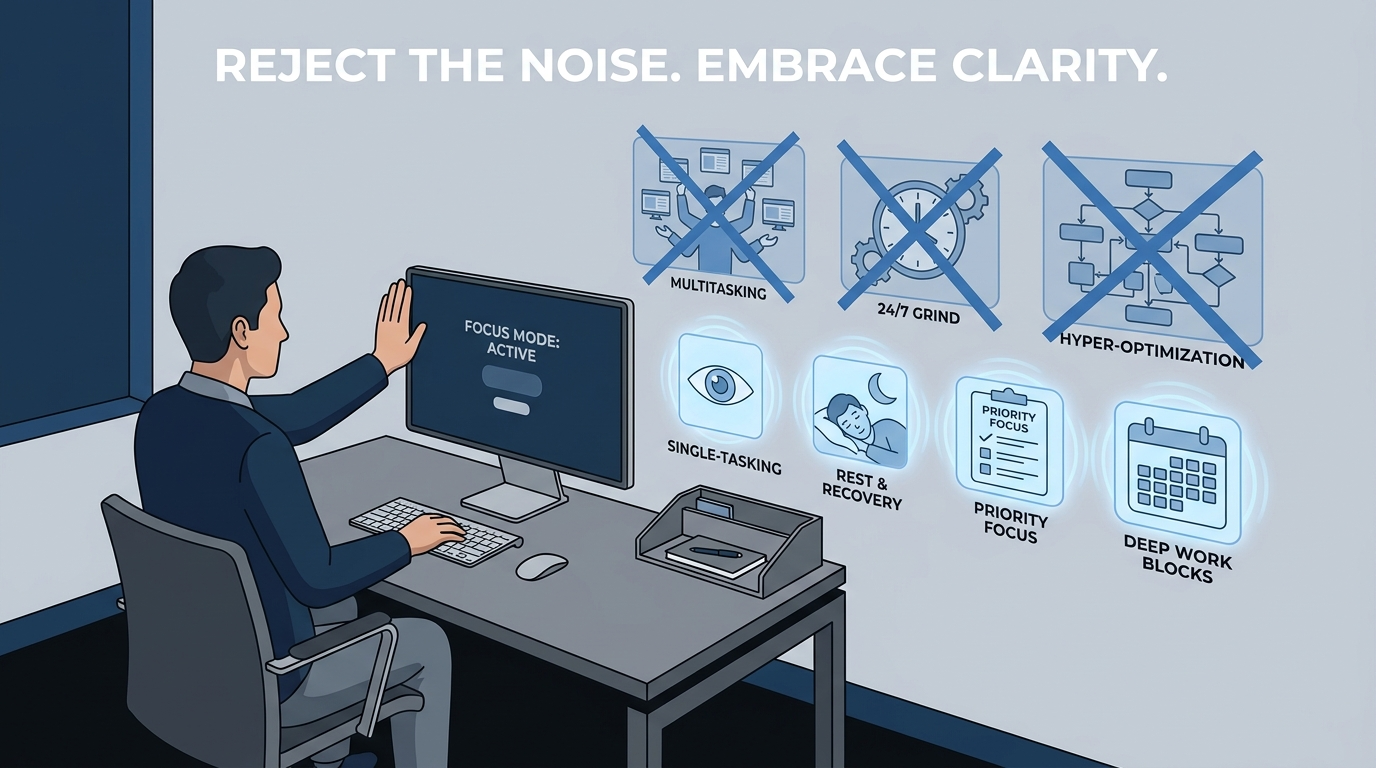
Myth #1: The "Always-On" Multitasking Mastery
The Folklore: Peak performers juggle multiple tasks simultaneously, responding to Slack while drafting reports while attending meetings. It's the badge of the perpetually busy.
The Reality Check: MIT neuroscientist Earl Miller's research shows that what we call multitasking is actually rapid task-switching—and it's murdering your cognitive capacity. Each switch creates a "attention residue" that can reduce productivity by up to 40%.
The Science-Backed Upgrade:
- Time-blocking with transition buffers: Schedule 15-minute gaps between different types of work
- Single-tasking sprints: Use the Pomodoro Technique, but customize intervals based on your attention data
- Communication batching: Check messages at predetermined times rather than reactively
One marketing director I worked with implemented this system and saw her project completion rate jump 60% in just three weeks. The secret? She stopped wearing busy-ness as a badge of honor.
Myth #2: The "Optimize Everything" Obsession
The Folklore: Track every metric, optimize every minute, biohack every bodily function. If you're not measuring your sleep cycles and optimizing your macro ratios, you're not serious about peak performance.
The Reality Check: Psychology professor Barry Schwartz's research on "The Paradox of Choice" reveals that excessive optimization can create decision fatigue and analysis paralysis. When everything becomes a variable to optimize, nothing gets the focused attention it deserves.
The Science-Backed Upgrade:
- The 80/20 Rule for Optimization: Identify the 20% of habits that drive 80% of your results
- Seasonal Focus Cycles: Pick one area to optimize per quarter, not everything simultaneously
- Good Enough Thresholds: Set "satisficing" standards instead of maximizing every decision
Instead of tracking seventeen different metrics, focus on two or three leading indicators that genuinely move the needle on your core objectives.
Myth #3: The "Grind Never Stops" Mentality
The Folklore: Real achievers work nights, weekends, and holidays. Rest is for the weak. Hustle culture demands constant motion toward your goals.
The Reality Check: University of Rochester's research on autonomous motivation shows that sustainable peak performance requires strategic recovery. The brain's default mode network—active during rest—is where breakthrough insights and creative connections happen.
The Science-Backed Upgrade:
- Ultradian rhythm awareness: Work in 90-120 minute focused blocks followed by 15-20 minute breaks
- Weekly reset rituals: Schedule complete disconnection periods for mental restoration
- Energy management over time management: Align your hardest work with your natural energy peaks
Research from the Energy Project found that employees who take regular breaks throughout the day report 23% higher levels of focus and 30% better ability to think creatively.
The Real Peak Performance Formula
Here's what the science actually tells us about sustainable high output:
Foundation Layer: Biological Optimization
Before you can hack your productivity, you need to respect your biology. Sleep quality beats sleep quantity every time. Focus on consistent sleep and wake times rather than chasing the perfect eight hours.
Systems Layer: Sustainable Workflows
Build systems that work with your brain's natural patterns, not against them:
- Batch similar tasks to reduce cognitive switching costs
- Use external systems (apps, calendars, templates) to reduce decision fatigue
- Create feedback loops to iterate and improve your approaches
Mindset Layer: Long-term Thinking
Peak performance isn't about this week or this month—it's about building capabilities that compound over time. What habits will make you more effective six months from now?
Your Anti-Folklore Action Plan
Ready to ditch the productivity folklore and embrace science-backed performance? Start with this systematic approach:
- Audit your current habits: Which "productivity" practices are you following without evidence?
- Run experiments: Test one change at a time for 2-3 weeks before adding another
- Track leading indicators: Focus on process metrics that predict results
- Build in recovery: Schedule rest and reflection as non-negotiable appointments
Remember, the goal isn't to become a productivity machine—it's to create sustainable systems that help you do your best work while maintaining your humanity.
Beyond the Myths: What Actually Works
The most successful professionals I've worked with share one common trait: they've stopped chasing productivity porn and started building personalized systems based on their unique work style, energy patterns, and life constraints.
They understand that peak performance isn't about following someone else's blueprint—it's about conducting thoughtful experiments, measuring what matters, and iterating toward approaches that genuinely serve their goals and values.
The next time you see a LinkedIn post promising the "one weird trick" to unlock your potential, ask yourself: Is this backed by evidence, or is it just another piece of folklore dressed up as wisdom?
Your future self will thank you for choosing science over stories, systems over shortcuts, and sustainability over sprint-and-crash cycles. That's where real peak performance lives—not in the myths, but in the mindful application of what actually works.


