
Morning Routine Myth: Why 5 AM Wake-Ups Kill Creativity
The Morning Routine Myth: Why Your 5 AM Wake-Up Could Be Sabotaging Creativity
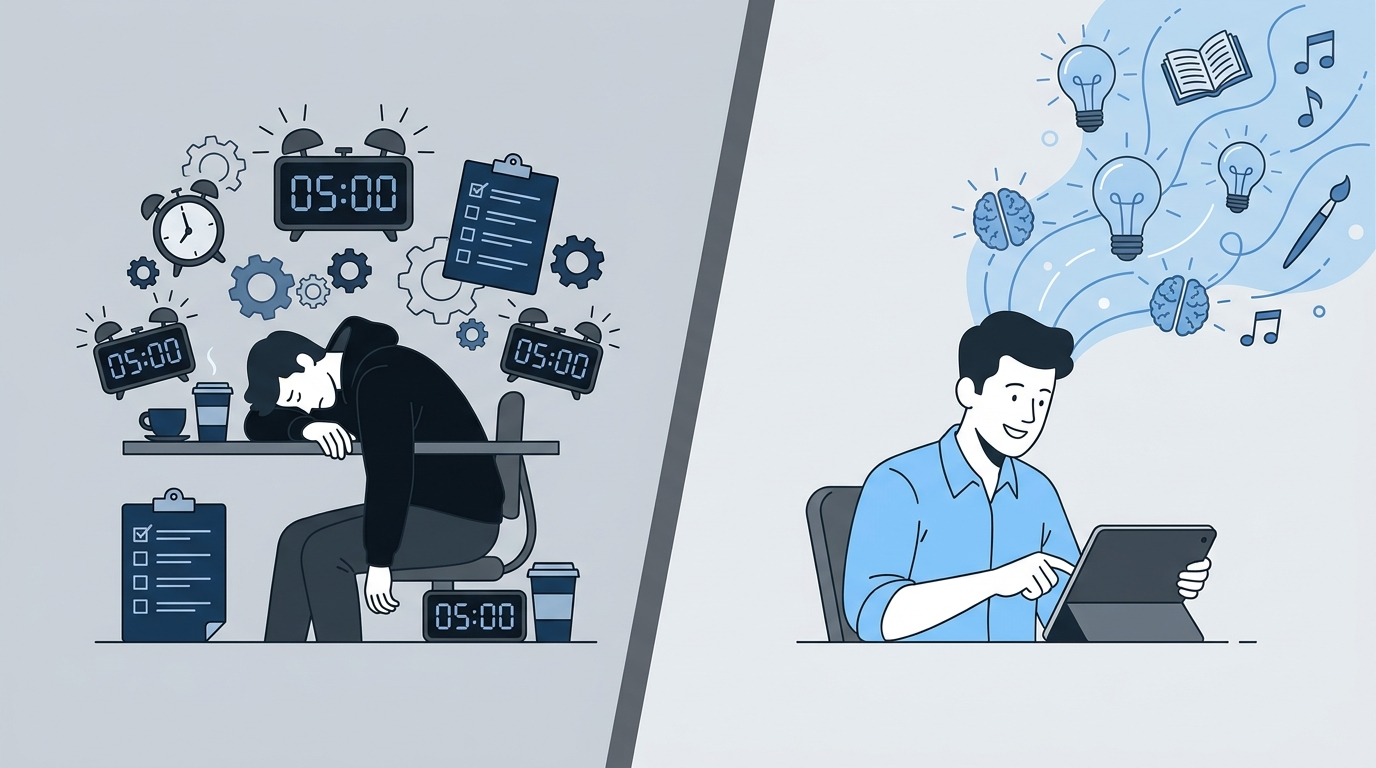
Picture this: It's 4:55 AM, your alarm screams bloody murder, and you're stumbling around like a zombie trying to meditate, journal, and optimize your mindset before the sun even thinks about rising. Sound familiar? You're not alone in this pre-dawn circus act that productivity gurus have convinced us is the secret sauce to success.
But here's a question that might shake up everything you've been told: What if the very routine you think is boosting your productivity is actually strangling your creative potential?
New research is flipping the script on the morning routine myth, revealing that for knowledge workers and creative professionals, those sacred 5 AM wake-ups might be doing more harm than good. Let's dig into why your natural rhythms might be smarter than Silicon Valley's sleep schedule.
The Science Behind Sleep and Creative Flow
Here's what the hustle gospel doesn't tell you: creativity isn't a morning person. Recent studies from the University of Toronto and Harvard Medical School show that creative problem-solving peaks during your personal "off-peak" hours—those times when your analytical brain takes a backseat.
Think about it like water flowing around rocks. When your executive function is running at full throttle (hello, 8 AM meetings), your brain becomes hyper-focused but loses that fluid, associative thinking that sparks breakthrough ideas. It's during those slightly drowsy, less structured moments that your mind makes unexpected connections.
Why 5 AM Wake-Ups Backfire for Creative Work
The 5 AM productivity routine creates several creativity-crushing problems:
- Sleep debt accumulation: Most people need 7-9 hours of sleep, but early risers often sacrifice evening wind-down time
- Cortisol spikes: Forcing yourself awake before your natural rhythm floods your system with stress hormones
- Reduced REM sleep: The final sleep cycles contain the richest REM phases crucial for creative processing
- Chronotype mismatch: Only about 25% of people are natural early birds—the rest are fighting their biology
The Real Data on Peak Creative Performance
Dr. Mareike Wieth's research at Albion College found something fascinating: people solved creative problems significantly better during their non-optimal times of day. Night owls performed better on creative tasks in the morning (when they're naturally groggy), while morning people excelled creatively in the evening.
This isn't about being lazy—it's about strategic cognitive flexibility. When your brain isn't running at peak analytical capacity, it becomes more open to novel associations and unconventional solutions.
Building a Creativity-Optimized Schedule Instead
Ready to ditch the 5 AM tyranny? Here's how to design a schedule that actually works with your creative brain:
- Identify your chronotype: Use the Munich Chronotype Questionnaire or simply track your energy patterns for two weeks
- Reserve creative work for your "fuzzy" hours: Schedule brainstorming, writing, and ideation when you're slightly tired but not exhausted
- Protect your sleep architecture: Aim for consistent sleep and wake times that allow for complete sleep cycles
- Use analytical peak times for execution: Save editing, data analysis, and detail work for when you're mentally sharp
The Myth of "Productive" Morning Routines
Let's be honest—most elaborate morning productivity routines are performative productivity theater. Meditation, cold showers, journaling, exercise, and green smoothies before 7 AM? That's not optimization; that's exhaustion disguised as discipline.
Instead of cramming every wellness trend into your morning, try this: do less, but do it intentionally. Pick one or two practices that genuinely energize you and skip the rest. Your creativity doesn't need a 12-step morning ritual—it needs space to breathe.
What Actually Boosts Creative Output
Research from Teresa Amabile at Harvard Business School identified the real drivers of creative work:
- Uninterrupted time blocks: Creativity needs sustained focus, not chopped-up morning chunks
- Psychological safety: Fear of judgment kills creative risk-taking
- Intrinsic motivation: Working on projects that genuinely matter to you
- Cross-pollination: Exposure to diverse ideas and experiences
Notice what's missing? Wake-up time isn't on the list.
Practical Systems for Creative Knowledge Workers
Here's a framework that honors your creative rhythms while staying productive:
The Creative Chronotype Method:
- Map your energy landscape: Track when you feel most alert, creative, and focused over two weeks
- Design your ideal day template: Block analytical work during peak hours, creative work during transitional times
- Create ritual anchors: Use small, consistent practices to signal work mode transitions
- Build in recovery rhythms: Schedule downtime that allows for mind-wandering and idea incubation
Breaking Free from Hustle Culture Guilt
The hardest part isn't changing your schedule—it's releasing the guilt around not being a 5 AM warrior. Remember: productivity isn't about looking busy or following someone else's template. It's about creating meaningful work that matters.
Your brain has its own optimal operating system. Why would you override millions of years of evolutionary programming because a productivity influencer said so?
The Bottom Line on Morning Routines
The morning routine myth persists because it feels like control in an chaotic world. But real productivity comes from understanding your unique cognitive patterns and designing systems that amplify your strengths rather than fighting your nature.
Instead of forcing yourself into someone else's schedule, experiment with working with your chronotype. You might discover that your most brilliant ideas come at 10 PM, not 5 AM—and that's perfectly fine.
Your creativity doesn't need to be optimized; it needs to be unleashed. Sometimes the most productive thing you can do is sleep an extra hour and trust that your well-rested brain will outperform any artificially enhanced morning routine.
Ready to design a schedule that actually works for your creative brain? Start by tracking your natural energy patterns this week, then experiment with matching your most important creative work to your optimal cognitive windows. Your breakthrough ideas are waiting—they're just operating on a different schedule than you thought.


