AI Productivity Myths: Why Most Advice Costs You Time
AI: Myth vs Machine: Why Most AI Productivity Advice Is Costing You Time, Not Saving It
Picture this: Sarah, a marketing director, just spent three hours crafting the "perfect" ChatGPT prompt to write a single email. Meanwhile, her colleague Jake automated the entire customer onboarding sequence in the same timeframe using a simple workflow tool. AI productivity advice flooded Sarah's LinkedIn feed with promises of 10x efficiency, but she's working harder than ever.
Sound familiar? You're drowning in AI productivity tips that promise everything but deliver chaos. The real question isn't whether AI can boost your productivity—it's whether you're falling for the myths that are secretly sabotaging your success.
The Great AI Productivity Paradox
Here's the uncomfortable truth: most AI productivity advice creates more work, not less. While productivity gurus push miracle prompts and expensive subscriptions, they're missing the fundamental flaw in their approach.
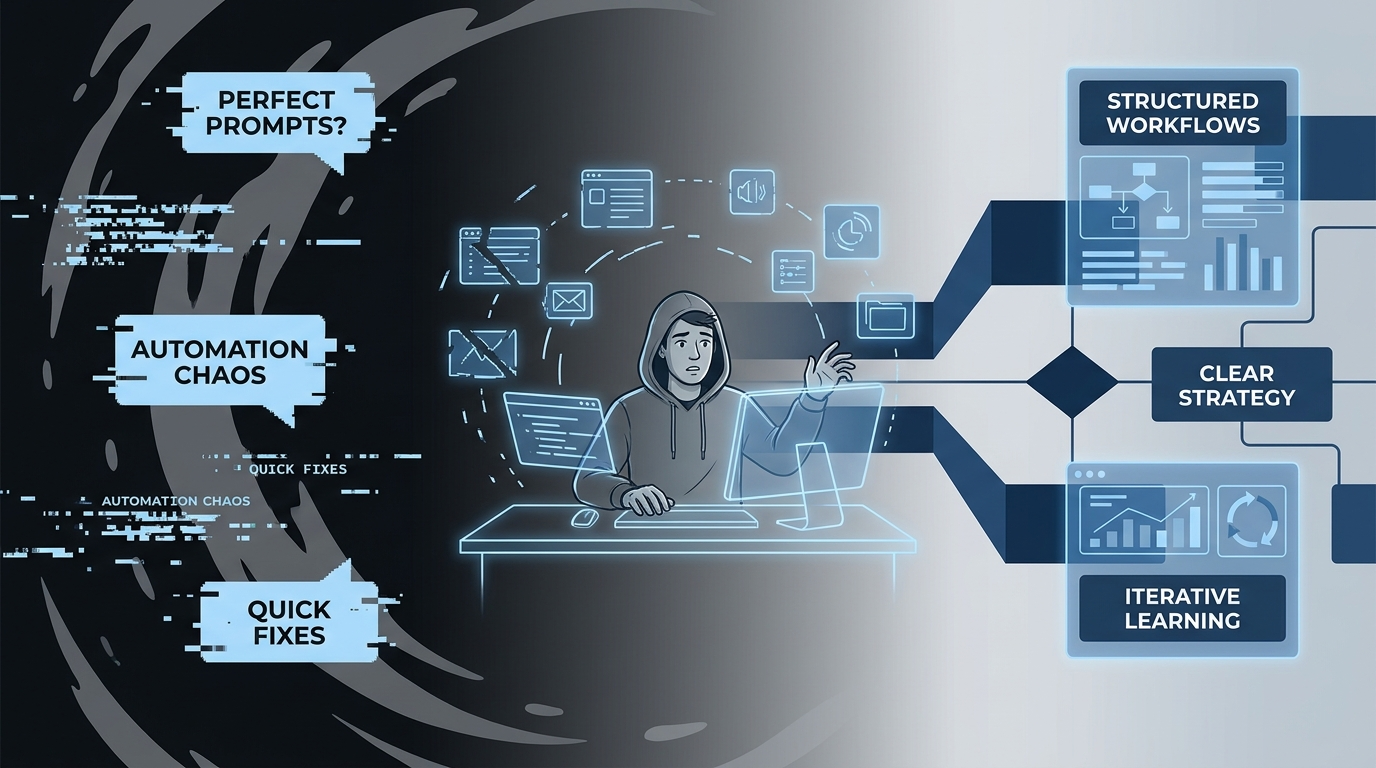
The problem isn't AI—it's the myth that productivity comes from perfect tools rather than systematic thinking. Real productivity gains happen when you build repeatable processes, not when you chase the latest AI shiny object.
Myth #1: The Perfect Prompt Will Save You
LinkedIn is littered with "game-changing" prompts that promise to revolutionize your workflow. The reality? Prompt paralysis is killing your momentum faster than any productivity gain you might achieve.
Why Prompt Obsession Backfires
- Time sink: Crafting elaborate prompts often takes longer than the original task
- Context switching: Constantly tweaking prompts breaks your flow state
- Inconsistent results: Perfect prompts rarely work the same way twice
- Dependency trap: You become reliant on external "magic formulas" instead of building judgment
Instead of chasing perfect prompts, focus on systematic AI integration. Build simple, repeatable processes that work consistently rather than sporadically brilliant ones that demand constant attention.
Myth #2: More AI Tools Equal More Productivity
Welcome to the subscription swamp—where productivity enthusiasts drown in monthly fees for tools they barely use. The average knowledge worker now juggles 15+ AI subscriptions, creating more overhead than efficiency.
The Hidden Costs of Tool Proliferation
- Learning curve tax: Each new tool requires time investment with no guaranteed return
- Integration nightmares: Multiple tools rarely play nice together
- Decision fatigue: Choosing between tools wastes more time than using suboptimal ones
- Maintenance burden: Updates, logins, and feature changes create constant friction
Smart productivity comes from tool consolidation, not accumulation. Identify the 2-3 AI tools that handle 80% of your needs, then ruthlessly eliminate the rest.
Myth #3: AI Should Replace Human Thinking
The biggest productivity lie? That AI should do your thinking for you. This creates learned helplessness where you can't function without AI assistance—the opposite of true productivity.
Real AI productivity amplifies human intelligence rather than replacing it. The goal isn't to eliminate thinking but to automate the repetitive tasks that drain your cognitive resources for higher-level strategy and creativity.
Signs You're Over-Relying on AI
- You can't write an email without ChatGPT
- Every task starts with "Let me ask AI first"
- You spend more time crafting prompts than executing solutions
- Your work quality suffers when AI tools are unavailable
The Real Path to AI Productivity
Forget the myths. Here's how to build sustainable AI productivity that actually saves time:
1. Start with Process, Not Prompts
Map your current workflows before adding AI. Identify repetitive tasks, decision points, and bottlenecks. Only then consider where AI can genuinely streamline operations.
2. Build Systems, Not Dependencies
Create AI-assisted workflows that function even when specific tools fail. Design backup processes and maintain your core skills while leveraging AI for acceleration, not replacement.
3. Measure Real Impact, Not Vanity Metrics
Stop counting how many prompts you've saved and start measuring actual outcomes:
- Time to completion: How long does end-to-end project delivery take?
- Quality consistency: Are outputs meeting standards without constant revision?
- Cognitive load: Do you feel more or less mentally exhausted?
- Strategic focus: Are you spending more time on high-value activities?
Practical Steps to Escape AI Productivity Traps
The 30-Day AI Audit
Ready to break free from productivity theater? Try this systematic approach:
- Week 1: Track every AI interaction. Log time spent, task completed, and actual value created
- Week 2: Identify your top 3 highest-impact AI use cases. Cancel subscriptions for tools you haven't used
- Week 3: Build simple workflows around your core AI tools. Focus on repeatability over perfection
- Week 4: Optimize workflows based on real usage data. Eliminate steps that add complexity without value
The "Good Enough" Principle
Perfectionist AI usage kills productivity. Embrace "good enough" outputs that you can quickly refine rather than spending hours crafting elaborate prompts for marginally better first drafts.
Remember: the goal isn't perfect AI outputs—it's faster iteration cycles that let you reach excellent final results more efficiently.
Building Your Anti-Myth AI Strategy
The most productive AI users aren't prompt wizards or tool collectors—they're systems thinkers who understand that technology serves process, not the other way around.
Your New AI Productivity Framework
- Clarity first: Define what success looks like before choosing tools
- Integration second: Ensure new AI fits existing workflows seamlessly
- Measurement third: Track real impact, not usage statistics
- Optimization last: Refine only after establishing baseline performance
This approach protects you from productivity snake oil while building genuine AI-powered efficiency that compounds over time.
The Reality Check
True AI productivity isn't about having the smartest prompts or the most subscriptions. It's about creating reliable systems that amplify your natural abilities while maintaining your independence and judgment.
The next time someone promises a revolutionary AI productivity hack, ask yourself: "Does this help me build better systems, or does it make me more dependent on external magic?"
Your future productive self will thank you for choosing sustainability over sensation, systems over shortcuts, and strategic thinking over tactical tool-chasing.
Ready to escape the AI productivity myth trap and build workflows that actually work? Start with your current processes, add AI strategically, and measure what matters. Your time is too valuable to waste on productivity theater.


