
AI Marketing Assistant Clichés: Fix Bland Copy Now
AI Marketing Assistant Clichés: Why Your Bot Sounds Like Everyone Else's—And How to Fix It
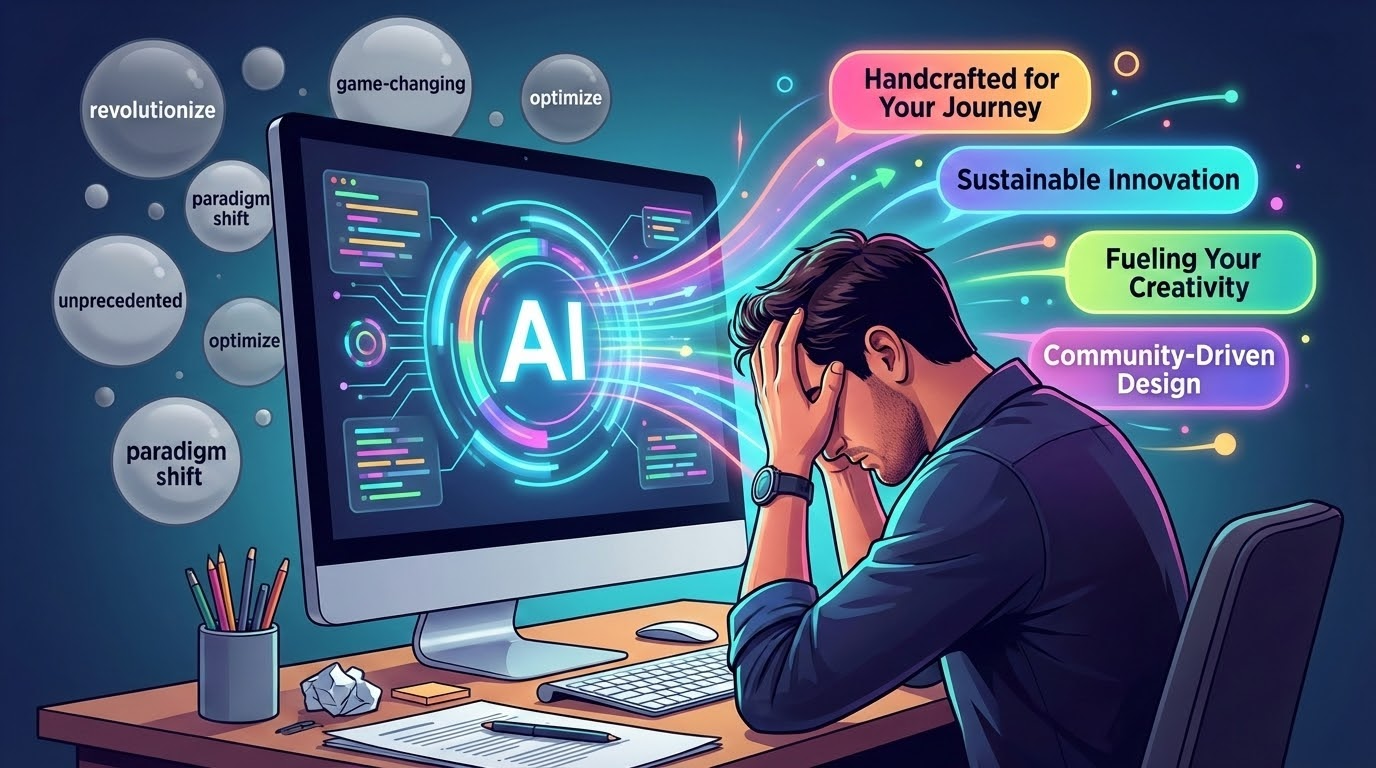
Picture this: You fire up your AI marketing assistant, feed it a prompt about your revolutionary new project management tool, and out comes "revolutionize your workflow with cutting-edge solutions that will take your business to the next level." Sound familiar? If your AI keeps serving up the same corporate word salad that's been circulating since 2019, you're not alone—but you're also not stuck with it.
Here's the thing about AI marketing assistants: they're incredible pattern-matching machines, but they're also trained on billions of web pages filled with... well, the same recycled marketing speak we're all tired of reading. The result? Copy that technically checks all the boxes but lands with all the impact of lukewarm coffee.
So how do you break your AI out of cliché jail and start generating copy that actually sounds like your brand? Let's dig into the real reasons this happens and the specific fixes that work.
Why AI Marketing Tools Default to Generic Copy
Before we jump into solutions, let's understand what's happening under the hood. Your AI marketing assistant isn't deliberately trying to bore your audience—it's doing exactly what it was trained to do: find the most statistically probable next words based on patterns it learned from training data.
The problem? Most marketing content online follows predictable formulas. When AI systems analyzed millions of landing pages, emails, and ads during training, they absorbed these patterns:
Superlative overload: "Best," "revolutionary," and "game-changing" appear everywhere
Vague benefit claims: "Boost productivity" without specifying how or by how much
Industry buzzwords: "Synergy," "leverage," and "optimize" dominate B2B copy
Generic emotional triggers: "Don't miss out" and "limited time" appear in countless campaigns
Your AI learned that these phrases frequently appear in marketing content, so it assumes they must be effective. But here's what it missed: correlation isn't causation. Just because these phrases are common doesn't mean they're compelling.
The Hidden Cost of Cookie-Cutter AI Copy
When your marketing sounds like everyone else's, you're not just losing brand differentiation—you're actively training your audience to ignore you. Think about it: how many times can someone read "streamline your workflow" before their brain automatically skips over it?
Even worse, generic AI copy can actually hurt your conversion rates. A recent study by conversion optimization firm Unbounce found that highly specific, brand-distinctive copy outperformed generic alternatives by an average of 23% across landing page tests.
The good news? Once you understand how to guide your AI marketing assistant properly, you can consistently generate copy that's both original and on-brand.
Fix #1: Feed Your AI Specific Context, Not Generic Prompts
The fastest way to improve your AI's output is to stop giving it homework assignments and start giving it briefings. Instead of "Write an email about our new feature," try something like:
"Write an email to busy project managers who've been burned by overpromising tools before. Our new feature automatically sorts tasks by actual impact (not just urgency), and early users report saving 3 hours per week on prioritization alone. Tone: confident but not pushy, like a colleague sharing a useful tip."
See the difference? You've provided:
Specific audience (busy project managers with past disappointments)
Concrete benefit (saves 3 hours weekly on prioritization)
Proof point (early user data)
Tone guidance (confident colleague, not salesperson)
This context gives your AI enough constraints to avoid generic territory while still allowing creative flexibility.
Fix #2: Inject Your Brand Voice Through Examples
Your AI doesn't automatically know whether your brand is playful or professional, technical or accessible. But you can teach it by providing examples of copy you love—either your own or from brands with similar voices.
Try this approach: "Here's how [Brand X] explains complex features simply: [paste example]. Now write about our analytics dashboard using a similar approach." This technique, called "few-shot prompting," helps your AI marketing assistant understand patterns beyond just keywords and structure.
For even better results, create a simple brand voice reference doc with:
Words we use: "Streamlined" instead of "optimized"
Words we avoid: "Synergy," "leverage," "disruptive"
Tone examples: "Helpful expert" not "pushy salesperson"
Customer language: How your audience actually describes their problems
Fix #3: Use the Constraint Paradox
Here's something counterintuitive: giving your AI more constraints often leads to more creative output. When you tell it to "write compelling copy," you get generic results because "compelling" could mean anything. But when you add specific constraints, magic happens.
Try prompts like:
"Explain this benefit using only concrete, measurable outcomes"
"Write this without using any superlatives (best, greatest, revolutionary)"
"Describe our software like you're explaining it to your skeptical uncle"
These constraints force your AI to find fresh approaches instead of defaulting to tired formulas.
Fix #4: Iterate and Refine in Real-Time
Don't treat your AI like a vending machine where you insert a prompt and accept whatever comes out. The best results come from treating it like a collaborative writing partner. When you get output that's too generic, respond with specific feedback:
"This is too corporate. Can you make it sound more conversational, like advice from a trusted consultant?" or "Good start, but can you replace the generic benefits with specific outcomes our customers mentioned?"
This iterative approach helps you train your AI marketing assistant to understand your preferences, leading to better first drafts over time.
Advanced Technique: The Perspective Shift
One of the most effective ways to break out of cliché territory is to change the perspective entirely. Instead of describing your product from your company's viewpoint, try prompts like:
"Write from the perspective of a customer explaining why they chose us to a colleague"
"Describe our solution like a problem it solved, not a product we built"
"Write like you're defending your recommendation to a budget-conscious boss"
These perspective shifts naturally lead to more authentic, specific language because they mirror real-world conversations rather than marketing presentations.
Measuring Your Progress
How do you know if your AI copy improvements are working? Look beyond just engagement metrics and track:
Distinctiveness: Does your copy sound different from competitors?
Specificity: Can readers understand exactly what you offer and why it matters?
Authenticity: Would a real customer use this language to describe your product?
Run A/B tests comparing your refined AI copy against your previous generic versions. Most marketers see immediate improvements in click-through rates and conversion quality when they implement these techniques.
The Bottom Line: Your AI Is Only as Good as Your Guidance
Your AI marketing assistant has incredible potential, but it needs your strategic thinking to unlock it. The difference between generic, forgettable copy and compelling, brand-specific content isn't the AI itself—it's how thoughtfully you guide it.
Start with just one piece of content this week. Pick your most important landing page or email campaign, and apply these techniques. Give your AI specific context, clear constraints, and iterative feedback. The difference will be immediately obvious—not just to you, but to your audience.
Because here's the truth: in a world where everyone has access to the same AI tools, your competitive advantage isn't the technology itself. It's your ability to wield it strategically, with clear intent and brand awareness.
Ready to transform your AI from a cliché generator into a brand-building powerhouse? Start with your next campaign prompt, and watch how small changes in guidance create dramatically better results.


