
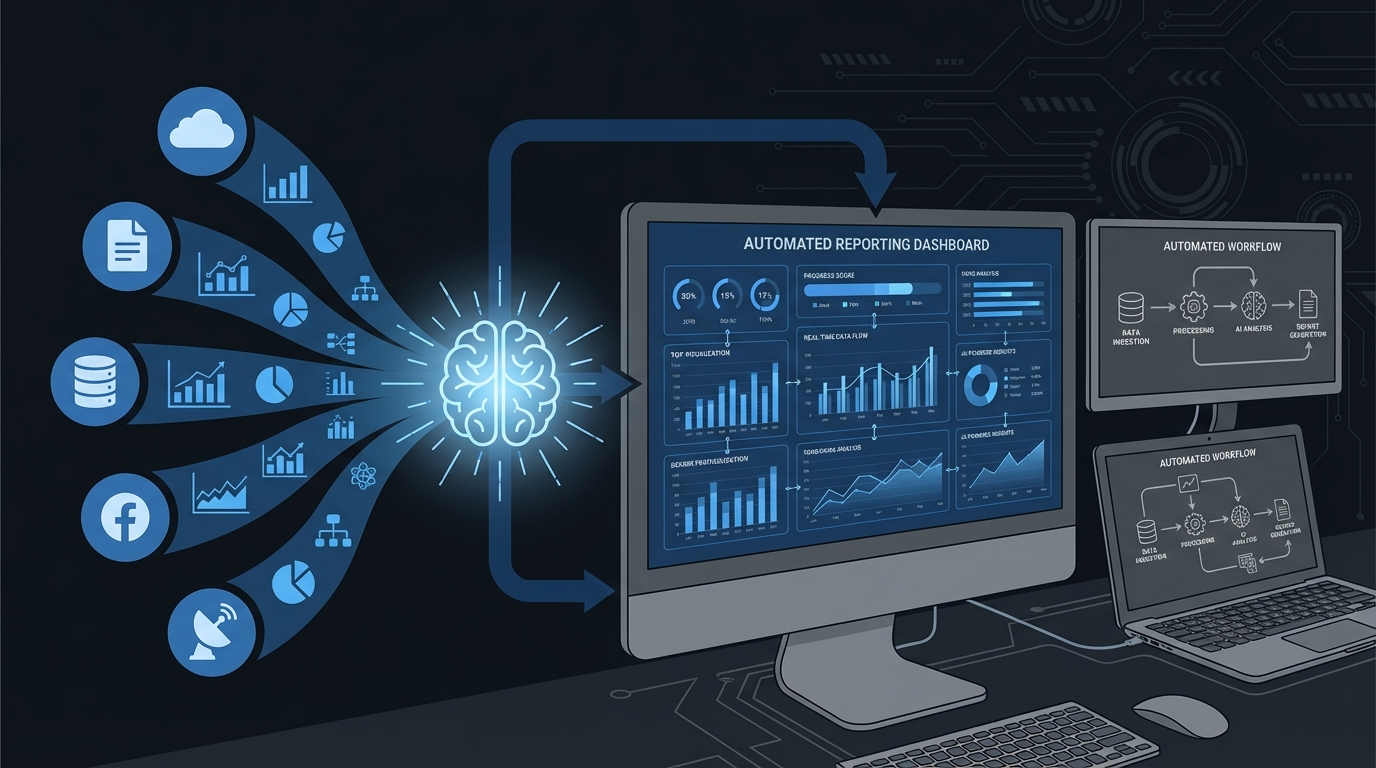
AI Adoption Case Study: Cut Reporting Time by 72% in 4 Weeks
Steal This Workflow: A Startup's 4-Week AI Adoption Case Study
Picture this: It's Monday morning, and instead of dreading the weekly reporting marathon that usually devours your entire day, you're sipping coffee while AI handles 72% of the work. Sounds like fantasy? That's exactly what happened at TechFlow Solutions—a 15-person startup that cracked the code on AI adoption without breaking their budget or sanity.
How could automating one workflow save you 10+ hours every week while actually improving accuracy and insights?
This isn't another fluffy AI success story. We're diving into the nitty-gritty of how a lean team transformed their most time-consuming process in just four weeks, complete with the exact workflow you can steal and implement today.
The Problem: Death by a Thousand Reports
TechFlow Solutions faced what many growing startups encounter—reporting hell. Every Monday, their operations manager Sarah would spend 6-8 hours manually:
- Pulling data from five different platforms
- Cross-referencing customer metrics
- Creating executive dashboards
- Writing narrative summaries for stakeholders
- Formatting and distributing reports
The kicker? By the time reports were ready Tuesday afternoon, the data was already stale. Leadership was making decisions based on yesterday's information, and Sarah was burned out from the repetitive grind.
"We knew we needed AI process automation, but every solution seemed designed for Fortune 500 companies," recalls Sarah. "We needed something that worked with our existing tools and wouldn't require a computer science degree to implement."
Week 1: Foundation and Tool Selection
Rather than diving headfirst into complex AI platforms, TechFlow started with a systematic approach to workflow automation:
Day 1-2: Process Mapping
The team documented their current reporting workflow, identifying:
- Data sources and access points
- Manual tasks vs. automatable processes
- Output requirements and stakeholder needs
- Pain points and bottlenecks
Day 3-5: Tool Evaluation
After researching AI automation tools, they selected:
- Zapier for basic data connections
- ChatGPT API for content generation and analysis
- Google Sheets as their central data hub
- Slack for automated notifications
Total setup cost? Under $200 per month—less than hiring a part-time intern.
Week 2: Building the AI Workflow Foundation
With tools selected, TechFlow began constructing their AI-powered reporting system:
Data Aggregation Setup
Using Zapier, they automated data pulls from:
- Salesforce (customer data)
- Google Analytics (website metrics)
- HubSpot (marketing performance)
- Stripe (financial data)
- Zendesk (support tickets)
Each integration fed into a master Google Sheet that updated automatically every hour.
AI Analysis Integration
Here's where the magic happened. They created custom ChatGPT prompts that would:
- Analyze weekly trends and anomalies
- Generate executive summaries in plain English
- Identify key insights and recommendations
- Format findings for different stakeholder groups
Pro tip: Start with simple prompts and refine them based on output quality. TechFlow went through 12 iterations before finding their sweet spot.
Week 3: Testing and Refinement
This phase focused on perfecting the AI workflow optimization:
Parallel Testing
For one week, they ran both the manual and AI-powered processes side by side, comparing:
- Accuracy of data interpretation
- Quality of insights generated
- Time savings achieved
- Stakeholder satisfaction with outputs
Iterative Improvements
Key refinements included:
- Adjusting AI prompts for better context
- Adding data validation checks
- Creating custom formatting templates
- Building error handling protocols
"The AI wasn't perfect immediately," notes Sarah. "But it was learning faster than any human could, and the time savings were already obvious."
Week 4: Full Implementation and Scaling
The final week focused on sustainable AI adoption:
Complete Workflow Automation
The finalized system now:
- Automatically pulls data every Monday at 6 AM
- Processes information through AI analysis
- Generates three report versions (executive, detailed, team-specific)
- Distributes via Slack and email by 8 AM
- Flags any anomalies for human review
Team Training and Handoffs
They created simple documentation so anyone could:
- Monitor the automated workflow
- Troubleshoot common issues
- Adjust AI prompts as business needs evolve
- Scale the system to additional reports
The Results: 72% Time Reduction in Numbers
After four weeks of AI implementation, TechFlow achieved remarkable results:
Time Savings
- Before: 8 hours of manual work per week
- After: 2.25 hours of oversight and refinement
- Reduction: 72% time savings (5.75 hours weekly)
Quality Improvements
- Reports delivered 24 hours earlier
- 95% accuracy maintained (vs. 89% manual accuracy)
- Consistent formatting and insights
- Real-time anomaly detection
Business Impact
- Faster decision-making with timely data
- Sarah redirected 6 hours weekly to strategic initiatives
- Improved stakeholder satisfaction with report quality
- Foundation for scaling additional automations
The Steal-Worthy Workflow: Your Implementation Guide
Ready to replicate TechFlow's success? Here's your AI adoption roadmap:
Phase 1: Preparation (Days 1-3)
- Map your current manual process
- Identify data sources and access requirements
- Define success metrics and output requirements
- Budget for tools ($150-300/month typically)
Phase 2: Tool Setup (Days 4-10)
- Create accounts for Zapier and ChatGPT API
- Set up data connections to your core platforms
- Build a central data aggregation sheet
- Test basic data flow automation
Phase 3: AI Integration (Days 11-20)
- Develop custom AI prompts for your use case
- Create automated workflows connecting data to AI
- Build output formatting and distribution systems
- Implement error handling and quality checks
Phase 4: Optimization (Days 21-28)
- Run parallel testing against manual processes
- Refine AI prompts based on output quality
- Document the workflow for team handoffs
- Plan scaling to additional processes
Critical Success Factors
TechFlow's success wasn't accidental. They focused on these AI adoption best practices:
- Start small: One workflow, not company-wide transformation
- Choose familiar tools: Build on existing tech stack
- Iterate quickly: Weekly refinements beat perfect planning
- Document everything: Make the system transferable
- Measure impact: Track time savings and quality metrics
Common Pitfalls and How to Avoid Them
Learn from TechFlow's early mistakes:
- Over-engineering initially: Start simple, add complexity gradually
- Ignoring data quality: Clean inputs create better AI outputs
- Perfectionism paralysis: 80% automation beats 0% perfection
- Skipping documentation: Future-you will thank present-you
Beyond Reporting: Scaling Your AI Success
With their first AI automation success, TechFlow has identified additional workflows for automation:
- Customer onboarding sequences
- Lead qualification and scoring
- Content creation and social media posting
- Invoice processing and financial reconciliation
"The reporting automation was just the beginning," reflects Sarah. "Now we see AI opportunities everywhere, and we have the confidence and framework to implement them systematically."
The key insight? AI adoption isn't about replacing humans—it's about freeing them to focus on high-value strategic work that actually moves the business forward.
Ready to reclaim your time and supercharge your startup's efficiency? Start with one workflow, follow TechFlow's proven framework, and watch as AI transforms your most tedious tasks into automated competitive advantages. Your Monday morning coffee will taste a whole lot better when you're not drowning in reports.


