Agentic AI Case Study: 3-Person Startup Cuts Support 40%
Agentic AI in the Wild: How a 3-Person Startup Cuts Support Tickets 40%
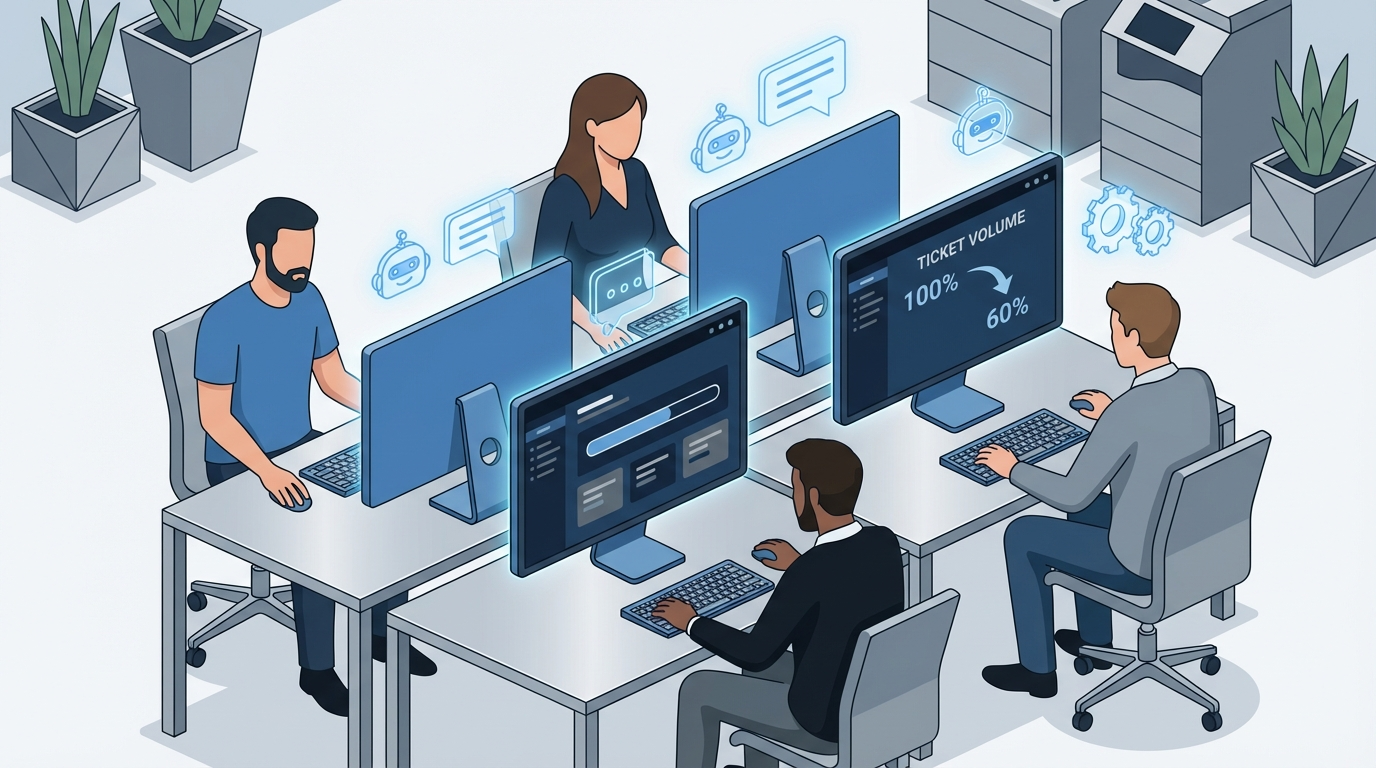
Picture this: You're drowning in customer support emails, your tiny team is burning out, and you're wondering if there's a life raft somewhere in the AI ocean. Sound familiar? That's exactly where CloudSync, a 3-person startup, found themselves three months ago. Today, they've reduced their support ticket volume by 40% using agentic AI—and they did it in just 7 days.
What if I told you that agentic AI isn't just another buzzword, but a practical solution that's already transforming how lean teams handle customer service? Let's dive into the exact system CloudSync built and how you can clone their success.
What Makes Agentic AI Different from Standard Chatbots
Traditional chatbots follow rigid scripts. They're like vending machines—you press the right buttons, you might get what you want. Agentic AI, however, operates more like a skilled customer service representative who can think, reason, and take initiative.
The key differentiators include:
- Autonomous decision-making based on context and customer history
- Multi-step problem resolution without human handoffs
- Learning from interactions to improve responses over time
- Integration with backend systems for real-time data access
CloudSync's founder, Sarah Chen, explained: "Our agentic AI doesn't just answer questions—it actively solves problems. It can check account statuses, process refunds, and even escalate complex issues with detailed context."
The 40% Reduction: Breaking Down the Numbers
Before implementing their agentic AI system, CloudSync processed an average of 200 support tickets weekly. Here's how those numbers shifted:
- Week 1 (pre-AI): 200 tickets, 40 hours of human support time
- Week 2 (AI implementation): 160 tickets, 28 hours of human support time
- Week 3 (optimized): 120 tickets, 20 hours of human support time
The magic wasn't just in volume reduction—it was in quality improvement. Customer satisfaction scores increased from 3.2 to 4.6 out of 5, primarily because the AI handled routine queries instantly while humans focused on complex problem-solving.
The Exact Prompt Library That Powers Their Success
CloudSync's agentic AI prompt library consists of five core prompt categories, each designed for specific customer service scenarios:
1. Initial Triage and Classification
This prompt helps the AI categorize incoming requests and determine the appropriate response pathway:
"Analyze this customer message and classify it into one of these categories: Technical Issue, Billing Question, Feature Request, Account Access, or General Inquiry. Consider the urgency level (High/Medium/Low) and identify any emotional indicators. Provide a brief reasoning for your classification and suggest the next best action."
2. Technical Problem Diagnosis
For technical issues, the AI uses this diagnostic approach:
"You are a technical support specialist. Based on the customer's description, systematically diagnose the issue by: 1) Identifying the specific product/feature involved, 2) Determining likely root causes, 3) Suggesting step-by-step troubleshooting, 4) Escalating if the issue requires developer intervention. Always ask clarifying questions if the initial description lacks critical details."
3. Billing and Account Resolution
This prompt handles the majority of routine account-related queries:
"Access the customer's account data and billing history. Address their concern by: 1) Explaining the current status clearly, 2) Identifying any discrepancies or issues, 3) Offering immediate solutions within policy guidelines, 4) Processing approved adjustments automatically. Maintain a helpful, empathetic tone throughout."
4. Escalation and Handoff
When human intervention becomes necessary:
"Prepare a detailed handoff summary including: 1) Customer background and history, 2) Specific issue description and attempted solutions, 3) Customer emotional state and communication preferences, 4) Recommended next steps and priority level. Ensure the human agent has all context needed for seamless continuation."
5. Follow-up and Satisfaction Check
Post-resolution engagement maintains customer relationships:
"Following up on the recently resolved issue: 1) Confirm the solution worked as expected, 2) Gather specific feedback on the support experience, 3) Identify any related concerns or questions, 4) Offer additional resources or proactive suggestions. Keep the tone friendly and genuinely interested in their success."
The 7-Day Implementation Blueprint
CloudSync's rapid deployment followed a systematic approach that any startup can replicate:
Day 1-2: Data Preparation and Analysis
- Export and categorize 3 months of historical support tickets
- Identify the top 10 most common inquiry types
- Document current response templates and escalation triggers
Day 3-4: AI Setup and Initial Training
- Configure the agentic AI platform with company-specific context
- Upload knowledge base articles and policy documents
- Test each prompt category with historical ticket examples
Day 5-6: Integration and Workflow Design
- Connect AI to existing helpdesk software and customer database
- Establish clear handoff protocols between AI and human agents
- Create monitoring dashboards for response quality and resolution rates
Day 7: Launch and Monitor
- Deploy AI for 50% of incoming tickets as a pilot test
- Monitor responses in real-time for accuracy and tone
- Collect immediate feedback from both customers and team members
The Critical Success Factors
Not every agentic AI implementation succeeds. CloudSync identified four critical factors that made their system work:
- Comprehensive knowledge base: The AI needs access to current, accurate information
- Clear escalation triggers: Define specific scenarios where human intervention is required
- Continuous feedback loops: Regular review and refinement of AI responses
- Team buy-in: Human agents must understand their evolving role in the new system
Measuring Success: Key Metrics to Track
CloudSync monitors several metrics to ensure their agentic AI system continues delivering value:
- First-contact resolution rate: Increased from 35% to 67%
- Average response time: Reduced from 4 hours to 12 minutes
- Customer satisfaction scores: Improved by 44%
- Agent productivity: 50% more time available for complex problem-solving
Common Pitfalls and How to Avoid Them
Through their implementation journey, CloudSync encountered several challenges:
- Over-automation: Initially tried to automate everything, leading to frustrated customers with complex issues
- Insufficient training data: The AI performed poorly until they provided more diverse examples
- Rigid response patterns: Early prompts were too restrictive, resulting in robotic interactions
The solution? Start conservative, focus on the most common and straightforward issues, and gradually expand the AI's capabilities based on performance data.
What's Next: The Future of Agentic AI in Customer Support
CloudSync isn't stopping at 40% reduction. Their roadmap includes:
- Predictive support: Identifying potential issues before customers report them
- Personalized interactions: Tailoring communication style to individual customer preferences
- Cross-platform integration: Expanding beyond email to chat, social media, and phone support
"The goal isn't to replace humans," Sarah notes, "it's to amplify human capability. Our agents now spend time on strategic customer relationships instead of password resets."
Ready to Clone Their Success?
The agentic AI revolution is happening now, not in some distant future. CloudSync's results prove that even resource-constrained startups can leverage this technology for immediate impact.
The question isn't whether you can afford to implement agentic AI—it's whether you can afford not to. Your customers expect faster, more accurate support, and your team deserves to work on meaningful challenges rather than repetitive tasks.
Start with CloudSync's blueprint. Adapt their prompt library to your specific industry and customer base. Most importantly, begin today—because while you're debating implementation, your competitors might already be cutting their support tickets by 40%.


