
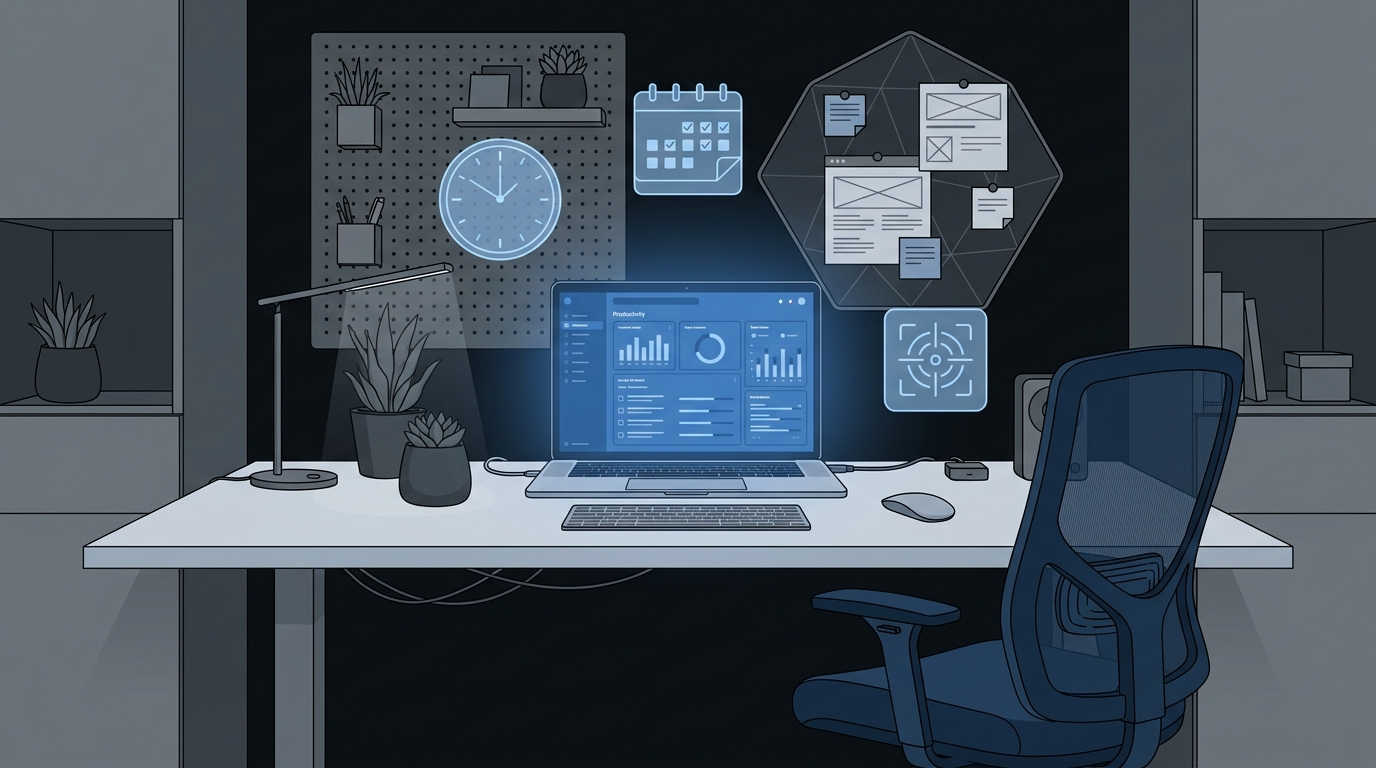
7 Remote Work Hacks to Reclaim 2 Lost Hours Daily
7 Remote-Work Hacks to Reclaim 2 Lost Hours a Day (Backed by 2026 Trend Data)
Picture this: You sit down at your home office at 9 AM with grand plans to tackle your priority project. By 11 AM, you've checked Slack seventeen times, answered three "quick" calls that weren't quick, and somehow found yourself reorganizing your desktop icons. Sound familiar?
Remote work is like having a Swiss Army knife—incredibly powerful when you know how to use each tool, but surprisingly easy to cut yourself with if you don't. The good news? Remote work productivity isn't about willpower or expensive apps. It's about systems that work with your brain, not against it.
Here's a question that might change how you think about your workday: What if those "lost" hours aren't really lost—they're just misdirected energy waiting to be channeled?
Recent 2026 workplace studies reveal that remote workers lose an average of 2.3 hours daily to preventable distractions, yet the top 20% of productive remote workers actually gain 1.5 hours compared to their office-bound counterparts. The difference? Seven key strategies that turn common WFH stumbling blocks into productivity springboards.
The 2026 Remote Work Reality Check
Before diving into solutions, let's acknowledge what we're working with. According to the latest Global Remote Work Productivity Index, here's what's stealing our time:
- Digital notification chaos: 47 minutes lost daily
- Household interruptions: 38 minutes
- Poor workspace ergonomics: 22 minutes (fatigue-related delays)
- Meeting overload: 31 minutes
- Task-switching penalties: 29 minutes
But here's the twist—each of these "problems" contains the seeds of its own solution. Let's unlock them.
Hack #1: The Notification Hierarchy System
The Problem: Your phone buzzes. Slack pings. Email chimes. Each notification fragments your focus, and it takes an average of 23 minutes to fully refocus after an interruption.
The Solution: Create a three-tier notification hierarchy:
- Tier 1 (Immediate): True emergencies only—family, critical work contacts
- Tier 2 (Batched): Check every 90 minutes—team communications, project updates
- Tier 3 (End-of-day): Everything else—newsletters, social media, non-urgent emails
Set your devices accordingly. Turn off badges, sounds, and pop-ups for Tier 2 and 3 notifications. Your brain will thank you with sustained focus blocks that compound throughout the day.
Hack #2: The Household Boundary Protocol
The Reality: Working from home means your space serves multiple masters—workspace, living space, sometimes even entertainment center.
The most productive remote workers in 2026 don't fight this reality; they structure it. Here's how:
- Visual work signals: Use a specific item (colored mug, desk lamp, even a hat) that signals "I'm in work mode" to household members
- The 15-minute rule: Handle non-urgent household requests in designated 15-minute breaks between focus blocks
- Productive procrastination: Keep a list of quick household tasks (5 minutes or less) for when you need a mental reset
This isn't about being antisocial—it's about being intentionally social during your designated break times.
Hack #3: The Ergonomic Energy Multiplier
Poor ergonomics doesn't just cause back pain—it creates cognitive drag. When your body is uncomfortable, your brain diverts energy to manage discomfort instead of focusing on tasks.
Quick wins that require zero budget:
- Stack books under your laptop to achieve eye-level screen height
- Use the 20-20-20 rule: Every 20 minutes, look at something 20 feet away for 20 seconds
- Set hourly movement reminders—even 30 seconds of stretching resets your system
2026 data shows that workers who implement basic ergonomic improvements see a 34% reduction in afternoon energy crashes.
Hack #4: The Meeting Audit Revolution
Not all meetings are created equal, but we treat them like they are. The most productive remote workers have become meeting curators, not just meeting attendees.
The three-question meeting filter:
- Could this be handled asynchronously?
- Do I need to contribute, or just receive information?
- Will this move a priority project forward this week?
If you can't answer "yes" to at least two questions, propose an alternative. Suggest a shared document for updates, a quick Slack discussion, or even a voice memo exchange.
One study participant reclaimed 45 minutes daily by simply asking, "What's the specific outcome we need from this meeting?" before accepting invitations.
Hack #5: The Context-Switching Shield
Task-switching isn't just inefficient—it's expensive. Each switch costs you cognitive resources and momentum. But rather than fighting switches, smart remote workers batch them strategically.
The Power Hour technique:
- Deep work blocks: 90-120 minutes of single-task focus
- Communication blocks: 20-30 minutes dedicated to emails, messages, quick calls
- Admin blocks: 15-25 minutes for scheduling, planning, file organization
Protect your deep work blocks fiercely. Schedule them like important meetings—because they are.
Hack #6: The Energy-Based Task Mapping
Your energy isn't constant throughout the day, so why should your task approach be? Map your highest-value work to your highest-energy hours.
Track your energy patterns for one week:
- Rate your mental clarity hourly (1-5 scale)
- Note when creative ideas flow easily
- Identify your natural focus peaks and valleys
Then align accordingly. Creative work during peak hours. Routine tasks during valleys. Administrative work during medium-energy periods.
This simple alignment can increase your effective output by 40-60% without working longer hours.
Hack #7: The Strategic Disconnection Practice
Constant connectivity is remote work's double-edged sword. The solution isn't to go offline completely—it's to go offline strategically.
The 90-minute offline sprint:
- Choose your most important task for the day
- Set your phone to airplane mode
- Close all browser tabs except what you need
- Work for 90 minutes straight
- Take a 15-minute connectivity break
2026 research shows that remote workers who implement regular offline sprints complete high-priority tasks 2.3x faster than those who stay constantly connected.
The Compound Effect: Why Small Systems Create Big Wins
Here's what makes these hacks powerful—they're not about perfection, they're about consistency. Implementing even three of these strategies can create a compounding effect where your reclaimed time creates space for even better systems.
Think of it this way: If you reclaim just 90 minutes daily through better systems, that's 7.5 hours weekly. Over a month, that's 30+ hours of focused work time. Over a year? Nearly 400 hours of productivity gains.
But the real magic happens when these systems become automatic. You stop spending mental energy deciding how to work and start directing that energy toward what matters most.
Your 7-Day Implementation Challenge
Don't try to implement everything at once. Here's your week-by-week rollout:
- Days 1-2: Set up your notification hierarchy
- Days 3-4: Implement household boundary signals
- Days 5-6: Optimize your workspace ergonomics
- Day 7: Plan your upcoming week using these new systems
Track your progress. Notice which hacks create the biggest impact for your specific situation. Then layer in the remaining strategies over the following weeks.
The Future of Remote Work Productivity
As we move deeper into 2026, remote work isn't going anywhere. But the workers who thrive will be those who master the fundamentals—focus, energy management, and intentional system design.
The question isn't whether you can be productive working remotely. The question is: Will you build systems that make productivity inevitable, or will you keep fighting the same battles every day?
Your reclaimed two hours are waiting. They're hidden in the systems you haven't built yet, the boundaries you haven't set, and the energy you haven't learned to direct strategically.
Ready to transform how you think about remote work productivity? Start with one hack today. Your future focused self will thank you.


