
1956 Productivity Lessons: Flying Cars to Task Management
From Flying Cars to Finishing Things: What 1956 Can Teach Your Productivity Stack
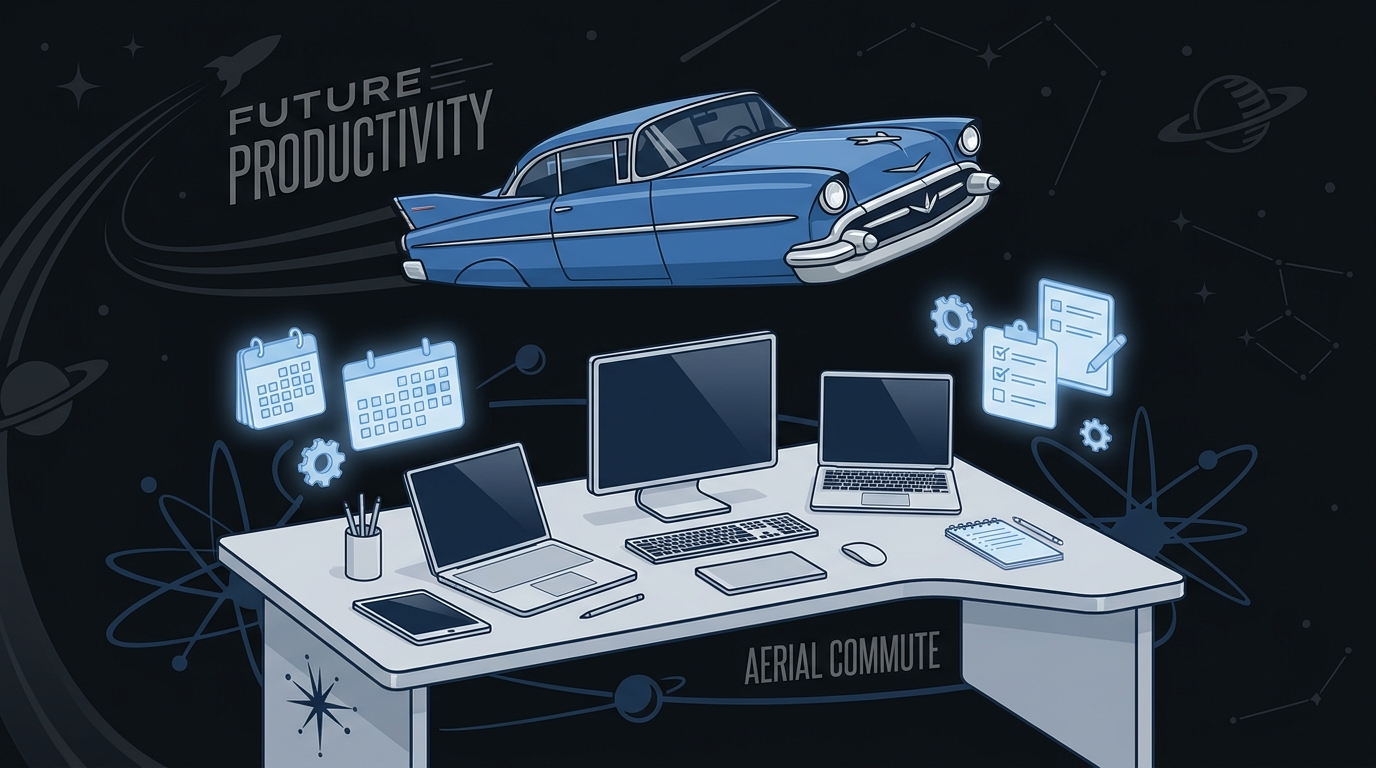
Picture this: It's 1956, and Popular Mechanics just promised you'd commute to work in a flying car by the 1980s. Fast-forward to 2026, and while we're still stuck in traffic jams, something fascinating happened along the way—those retro productivity visions actually cracked the code on getting things done.
Here's the wild part: The same mindset that dreamed up jetpacks and robot butlers contains the exact blueprint for conquering your modern task chaos. How could 70-year-old thinking possibly save you from Slack overwhelm and endless Zoom fatigue?
The 1956 Mindset: Systems Over Gadgets
While everyone fixated on the flying cars, 1950s futurists were quietly mapping out something revolutionary—systematic thinking. They didn't just imagine cool gadgets; they envisioned entire workflows redesigned around efficiency and automation.
This systematic approach mirrors what productivity experts call "systems thinking"—the idea that sustainable results come from processes, not tools. Your great-grandfather's generation understood something we've forgotten: the system is the solution.
Lesson 1: The Assembly Line Brain (Batch Processing)
Henry Ford revolutionized manufacturing in the early 1900s, but by 1956, futurists were applying assembly line thinking to knowledge work. They imagined automated offices where similar tasks flowed through dedicated "stations."
Modern translation: Batch processing your digital tasks. Instead of ping-ponging between emails, writing, and meetings, create dedicated time blocks for each activity type.
How to implement this today:
- Email batching: Check and respond to emails at set times (9 AM, 1 PM, 5 PM) rather than constantly
- Content creation blocks: Dedicate 2-3 hour chunks solely to writing, designing, or coding
- Meeting clusters: Stack similar meetings back-to-back on specific days
- Administrative hours: Bundle invoicing, planning, and organizational tasks into focused sessions
This approach reduces context-switching fatigue—the mental exhaustion from jumping between different types of work. Studies show task-switching can reduce productivity by up to 40%.
Lesson 2: The Push-Button Philosophy (Automation First)
1956's future promised a push-button world where complex processes happened automatically. While we didn't get robot maids, we got something better: digital automation that actually works.
The key insight from 1950s futurism? Automate the routine to amplify the remarkable. They understood that human creativity flourishes when mundane tasks disappear.
Your 2026 automation stack:
- n8n workflows: Automate data transfers between your apps (CRM to email to project management)
- Calendar automation: Set up automatic meeting prep, follow-up emails, and time blocking
- Content pipelines: Use AI to draft, humans to refine, automation to distribute
- Financial workflows: Automatic expense tracking, invoicing, and budget alerts
The 1956 lesson here? Don't automate everything—automate the right things. Focus on repetitive tasks that drain mental energy without adding value.
Lesson 3: The Jet Age Speed Mindset (Rapid Prototyping)
The jet age wasn't just about faster travel—it represented a fundamental shift toward rapid iteration. 1956 futurists believed in testing ideas quickly rather than perfecting them slowly.
This mirrors modern agile methodology and rapid prototyping. Instead of spending months perfecting a project, launch a minimal version and improve based on real feedback.
Apply jet-age thinking to your projects:
- Ship early versions: Launch with 80% perfection rather than waiting for 100%
- Weekly iterations: Make small improvements consistently rather than major overhauls
- Feedback loops: Build mechanisms to gather and act on user input quickly
- Fail fast: Test risky assumptions early when changes are still cheap
Lesson 4: The Space Race Organization (Mission-Driven Focus)
By 1956, the space race was heating up, introducing a powerful productivity concept: mission-driven organization. Everything aligned toward a single, audacious goal with clear deadlines.
This translates directly to modern productivity: organize your tasks and projects around clear missions with defined outcomes and timelines.
Structure your work like a space program:
- Define your moon shot: What's your big, time-bound goal for the next 90 days?
- Break into missions: Divide the big goal into 2-week "missions" with specific deliverables
- Daily mission control: Brief check-ins to ensure everything stays on trajectory
- Post-mission analysis: Review what worked and what didn't after each sprint
Lesson 5: The Television Network Model (Scheduled Broadcasting)
1956 marked television's golden age, when networks mastered the art of scheduled content delivery. Shows aired at specific times, audiences knew when to tune in, and consistency built massive engagement.
Apply this to your productivity by creating "broadcast schedules" for your most important work. When do you consistently produce your best thinking? When are you naturally most creative or analytical?
Design your personal broadcast schedule:
- Prime time creativity: Schedule your most important creative work during your peak energy hours
- Regular programming: Establish consistent times for regular activities (planning, email, learning)
- Special broadcasts: Block time for important but irregular tasks (strategy sessions, deep research)
- Reruns and maintenance: Schedule time for reviewing, organizing, and maintaining your systems
The 1956 Integration: Building Your Retro-Future Productivity Stack
Here's how to combine these vintage insights into a modern productivity system:
Morning Mission Control (15 minutes):
- Review your current "mission" objectives
- Identify today's batch processing blocks
- Check automated workflows for any issues
- Set your broadcast schedule for the day
Weekly Space Program Review (30 minutes):
- Assess progress toward your 90-day moon shot
- Plan next week's missions and iterations
- Optimize automation workflows
- Schedule batch processing blocks for the coming week
Why 1956 Got It Right (And We Got It Wrong)
The difference between 1956's productivity vision and our modern reality comes down to intentional design versus reactive scrambling. They imagined systems that served human potential; we often build systems that demand human sacrifice.
The 1956 approach prioritized:
- Systematic efficiency over individual heroics
- Purposeful automation over mindless busyness
- Mission clarity over task chaos
- Scheduled focus over always-on availability
These principles create what productivity researchers call "sustainable high performance"—the ability to maintain excellent output without burning out.
Your 30-Day Retro-Future Challenge
Ready to transform those flying car dreams into finishing-things reality? Start with one lesson per week:
Week 1: Implement batch processing for your three most frequent task types
Week 2: Set up one automation workflow that saves you 30+ minutes weekly
Week 3: Define your 90-day moon shot and break it into 2-week missions
Week 4: Create and test your personal broadcast schedule
The beauty of the 1956 productivity model? It's antifragile—these systems get stronger with use and adapt well to changing circumstances. Whether you're managing a startup, leading a team, or juggling multiple projects, these vintage insights create modern productivity wins.
Who knew that the secret to conquering your 2026 task list was hiding in a 1956 magazine all along? Sometimes the future is found by looking backward—not for nostalgia, but for timeless principles that transcend any particular technology or trend.


